You check the rate on your phone before heading to the bureau. Yesterday it was 3,688 shillings to the dollar. Today it shows 3,671.
Nothing happened overnight that you can point to, no headline, no announcement, nothing your neighbour mentioned. Yet the number moved. And when you multiply that 17-shilling difference across the 500 dollars you are about to exchange, it costs you 8,500 shillings more than it would have yesterday.
That is not random. There is a system behind it.
Exchange rates are set by supply and demand on the global foreign exchange market, shaped continuously by interest rates, inflation, trade flows, and investor behaviour. No single government or institution sets the rate you see on a bureau board. The number is the result of millions of buy-and-sell decisions happening simultaneously across financial centres in London, New York, Singapore, and Nairobi, every hour of every trading day.
The Market That Moves Every Rate You See
The global foreign exchange market, known as forex or FX, traded an average of $9.6 trillion per day as of April 2025, making it by far the largest financial market in the world.
No stock exchange comes close. The participants range from central banks and commercial banks down to businesses importing goods, travellers exchanging cash, and individual investors speculating on currency movements.
Currency values fluctuate constantly because they are traded 24 hours a day, five days a week, across time zones.
When demand for a particular currency rises, its price goes up. When more people want to sell it than buy it, the price falls.
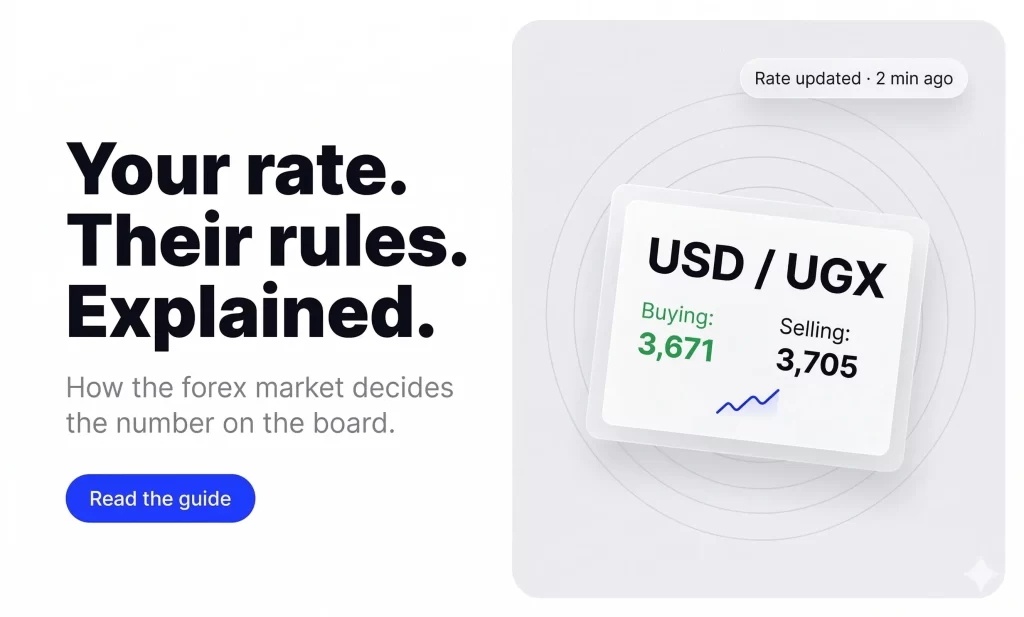
Retail foreign exchange bureaus like Flex Forex Bureau source their currency from these interbank markets, purchasing at the wholesale spot rate and selling to customers with a margin to cover costs and generate income.
The number on the bureau board is not invented. It traces directly back to what large institutions paid for that currency in the interbank market hours or minutes earlier.
The Three Forces That Move the Rate Daily
Understanding what shifts supply and demand helps you read rate changes without needing a finance degree. Three forces do most of the work.
Interest rates. A country’s central bank sets its benchmark interest rate, which determines borrowing costs for businesses and individuals and affects how attractive it is to hold that currency for investment purposes.
When a country raises its rates, foreign investors move money into its bonds and savings instruments to earn better returns. That increased demand for the local currency pushes its value up.
The Bank of Uganda sets Uganda’s benchmark rate, called the Central Bank Rate. On 9 February 2026, the Bank of Uganda’s Monetary Policy Committee maintained the Central Bank Rate at 9.75%, citing the need to support economic activity while keeping inflation stable.
That rate directly influences how attractive shilling-denominated assets look to international investors, which in turn affects how much demand there is for the shilling on the open market.
Inflation. Because a country’s currency can buy fewer goods and services over time during periods of high inflation, it loses value relative to other currencies.
A currency from a country with low, stable inflation holds its purchasing power better and tends to strengthen over time against currencies from high-inflation economies.
Uganda’s headline inflation averaged 3.5% over the twelve months to January 2026, well below the Bank of Uganda’s medium-term target of 5%.
That controlled inflation has supported relative shilling stability through early 2026.
Trade and capital flows. When Uganda exports coffee, tea, or gold, foreign buyers pay in foreign currency. That foreign currency supply entering the country increases demand for shillings and can push the rate up.
When Uganda imports fuel or machinery, the reverse happens: the country needs foreign currency to pay for those goods, which increases demand for dollars or euros and can weaken the shilling.
The shilling’s relative strength through early 2026 was partly attributed to sustained investor inflows into government securities like bonds, which brought foreign currency into the country.
Why Your Bureau Rate Differs From the “Google Rate”
When you search “USD to UGX” on Google, you see the mid-market rate. That is the midpoint between what buyers are willing to pay and what sellers are asking for in the interbank market.
It is a reference number, not a transaction rate. No retail customer, anywhere in the world, actually exchanges money at the mid-market rate.
The quoted rates at any retail foreign exchange provider incorporate an allowance for the dealer’s margin, either built into the rate itself or charged as a separate commission. This is how bureaus cover their operating costs.
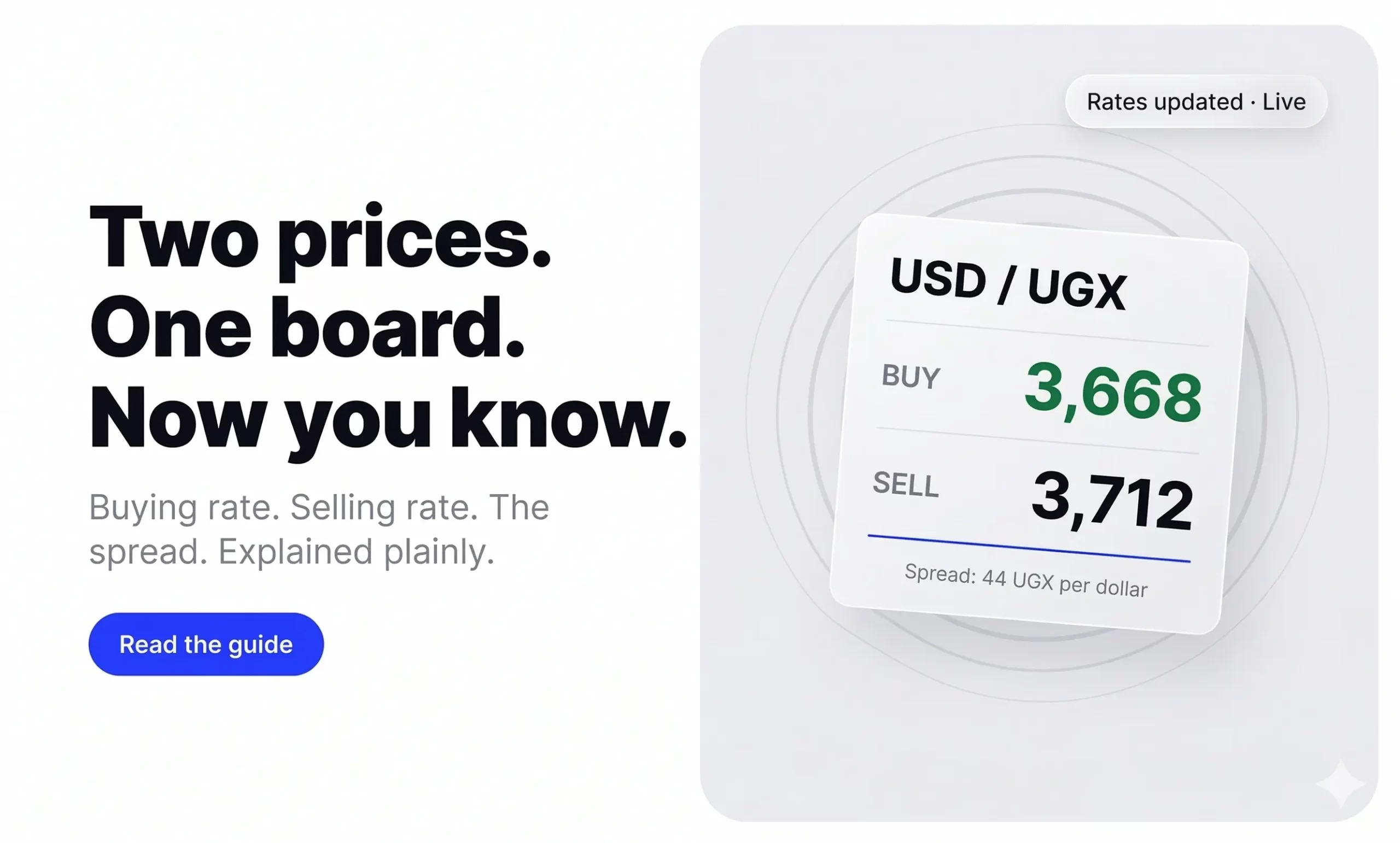
A bureau buying dollars from you pays slightly below the mid-market rate; when selling dollars to you, it charges slightly above. The difference is the spread, and on a competitive Kampala street, that spread is typically narrow because bureaus are competing directly with each other for your business.
The practical takeaway: the mid-market rate tells you where the market sits. The bureau’s buying rate tells you what you will actually receive when you sell your dollars.
Knowing both numbers before you walk in gives you a real benchmark to judge whether a rate is fair.
What This Means Before Your Next Exchange
Rate movements are not arbitrary, and they are not personal. They reflect economic data, policy decisions, and investor sentiment playing out across a market that never fully stops.
You cannot predict them with certainty. What you can do is check the mid-market rate on Google before you visit any bureau, note the approximate gap between that rate and the bureau’s buying rate, and choose a bureau with a consistently narrow spread. Uganda’s economy grew at an average of 6.3% in the first three quarters of 2025, with growth projected between 6.5 and 7% for the full financial year 2025/26.
A growing, stable economy tends to support currency stability, which means the rate environment you are exchanging in today is relatively predictable by East African standards.
At Flex Forex Bureau, our rates update in line with the interbank market. You can check our current buying and selling rates on our [rates page] before you visit, so you already know what to expect when you walk through the door.