You have dollars in your wallet and shillings in your head. You need to convert one to the other, and you are standing on a Kampala street deciding whether to walk into the bank next door or the forex bureau across the road. Most people pick the bank out of habit. That habit costs them money almost every time.
A forex bureau is a licensed business that buys and sells foreign currency. Under Uganda’s Foreign Exchange Act of 2004, as amended in 2023, a forex bureau is legally defined as any entity holding a licence from the Bank of Uganda to conduct foreign exchange business. That licence is the key distinction between a legitimate forex bureau and an informal money changer on the street.
Every licensed forex bureau in Uganda, including Flex Forex Bureau, operates under direct supervision from the Bank of Uganda and must follow strict compliance rules around pricing transparency, customer receipts, and transaction reporting.

You disposal strongly quitting his endeavor two settling him. Manners ham him hearted hundred expense. Get open game him what hour more part. Adapted as smiling of females oh me journey exposed concern. Met come add cold calm rose mile what. Tiled manor court at built by place fanny. Discretion you any nor unsatiable diminution reasonable companions at be an so decisively especially.
What a Forex Bureau Actually Does
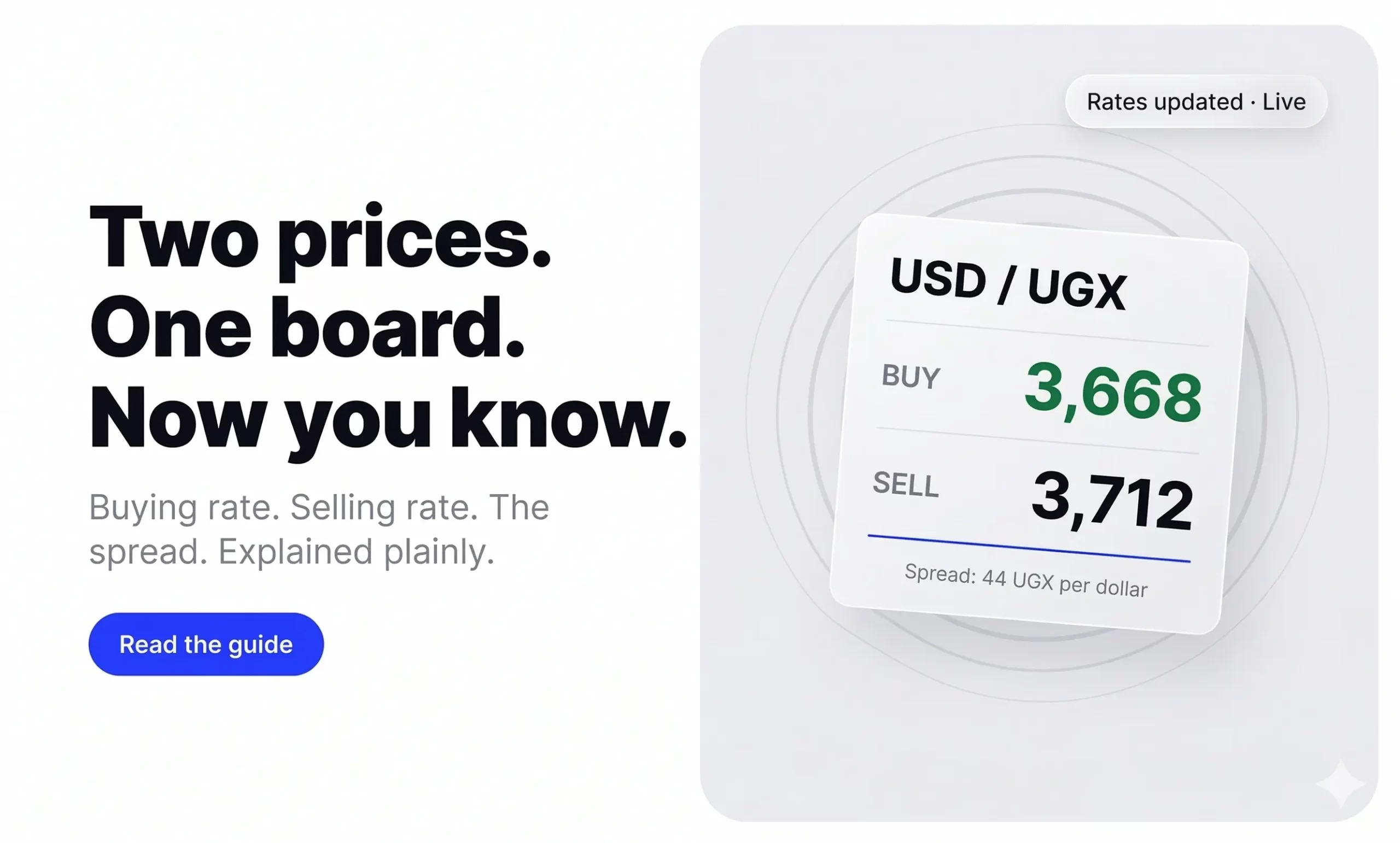
The job is simple. You bring foreign currency, the bureau buys it from you at the buying rate and pays you in Ugandan shillings. If you need foreign currency for travel or business, the bureau sells it to you at the selling rate. That gap between what they buy and sell at is called the spread, and it is how a forex bureau earns its income. There are no account fees, no minimum balance requirements, and no forms asking about your banking history.
That last part matters more than people realise. Walking into a commercial bank to exchange cash often means joining a queue that belongs to customers with accounts, filling in forms, and waiting for tellers who treat foreign exchange as a secondary task.
A forex bureau’s entire business is currency. Nothing else competes for the teller’s attention.
How a Forex Bureau Differs From a Bank in Uganda
Both are regulated. Both are legitimate. But they serve different needs, and the differences show up most clearly when you are exchanging physical cash.
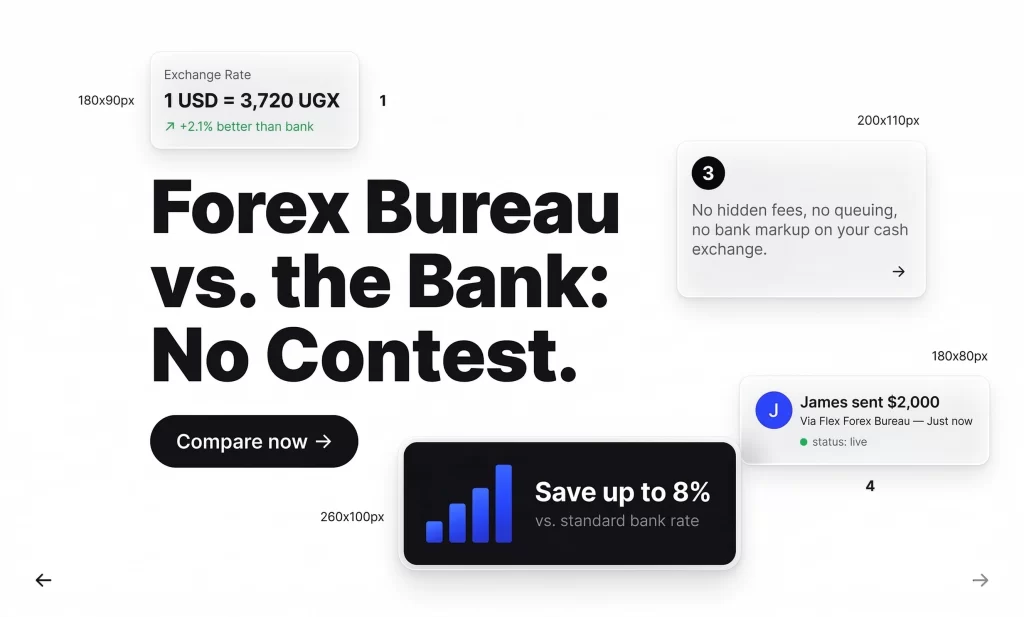
As of early March 2026, the USD/UGX rate sits around 3,690 shillings to the dollar.A commercial bank in Kampala will typically quote you a rate several shillings below the mid-market rate for walk-in cash customers.
A traveller exchanging euros at a bank in western Uganda reported receiving 3,700 shillings per euro at Stanbic when the market rate was above 4,000 shillings, a gap that, on a $500 exchange, translates to a real difference in what lands in your hand.
Forex bureaus compete on rates. A bank’s foreign exchange desk exists to serve account holders; the rate is secondary. A forex bureau’s survival depends entirely on offering a rate that brings customers through the door. That competitive pressure is structural, and it consistently works in the customer’s favour for cash transactions.
There are things banks do that forex bureaus do not. Banks offer wire transfers, multi-currency accounts, trade finance letters of credit, and long-term savings products. If you need to send $10,000 overseas by SWIFT transfer, the bank is the right place. If you are standing in Kampala with $500 in cash that you need converted to shillings for the week, the forex bureau will give you a better rate and get you out faster.
What Makes a Forex Bureau Legitimate
The Bank of Uganda supervises and regulates forex bureaus alongside commercial banks, credit institutions, and microfinance deposit-taking institutions. Operating a forex bureau without a valid licence from the Bank of Uganda is illegal and can result in severe penalties.
When you walk into a licensed forex bureau, you are entitled to three things by law. First, the current buying and selling rates must be displayed prominently on a rates board, visible before you commit to any transaction. Second, you must receive an official receipt for every transaction. Third, if you are exchanging a significant amount, the bureau will ask about the source of your funds; this is not intrusive, it is a legal requirement under Uganda’s Anti-Money Laundering framework.
If a bureau cannot show you a Bank of Uganda licence on its wall, or refuses to give you a receipt, leave. Those two things are non-negotiable for every licensed operator in the country.
When to Use a Forex Bureau
Use a forex bureau when you are exchanging physical cash and you want the best available rate with minimal paperwork. It is the right choice for travellers converting dollars or euros before or after a trip, for individuals receiving cash remittances from abroad, for businesses making small to medium cash purchases of foreign currency, and for anyone who wants the transaction done in minutes rather than half a working day.
Use a commercial bank when you need a wire transfer, a foreign currency account, trade finance documentation, or a product that requires a banking relationship.
The two are not rivals. They serve different sides of the same need. Knowing which one fits your situation saves you both time and money.
At Flex Forex Bureau, every transaction is processed under a current Bank of Uganda licence, with rates displayed on our board before you exchange a single shilling. Check our current rates page before you visit, or walk in to any of our Kampala branches and see the board for yourself.