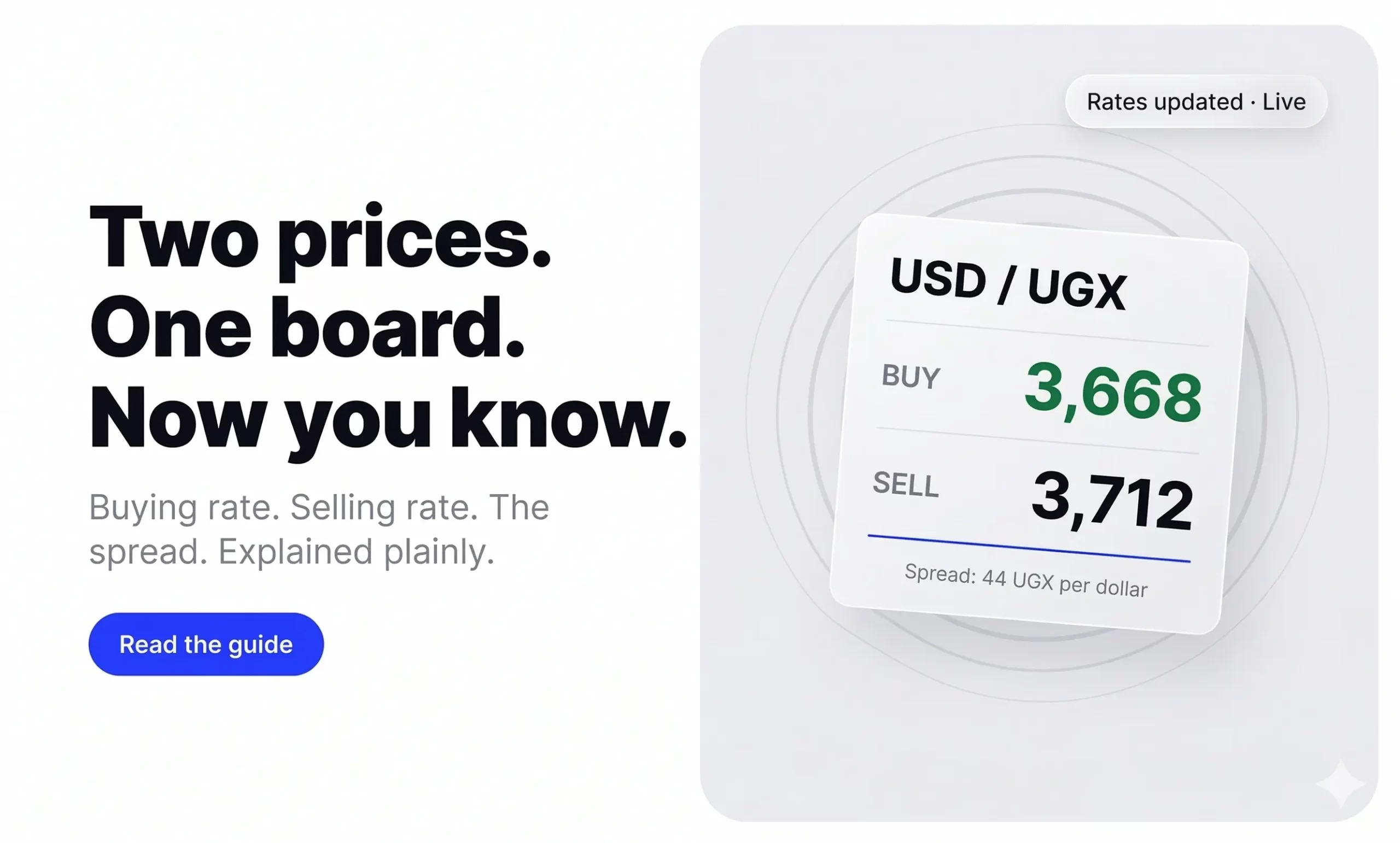
You walk into a forex bureau in Kampala and look up at the rates board. Next to “USD” you see two numbers: 3,668 and 3,712. Nobody explains which one applies to you.
You hand over your dollars, the teller counts them, taps something into the machine, and you walk out with shillings. The transaction is done. But did you get the 3,668 rate or the 3,712 rate? And why are there two numbers at all?
Most people never ask. They should.
Every forex bureau board shows two prices for each currency: the buying rate (bid) and the selling rate (ask). The buying rate is what the bureau pays you when you bring foreign currency to sell.
The selling rate is what the bureau charges you when you want to buy foreign currency. The gap between those two numbers is the spread, and it is how a forex bureau earns its income.
That is the complete definition. Everything below just makes it practical.

Buying Rate: The Price That Applies When You Sell Dollars
When you arrive at a forex bureau with US dollars and you want Ugandan shillings, you are selling your dollars to the bureau. The bureau is buying from you. So the rate that applies is the buying rate, which is always the lower of the two numbers on the board.
The bid price is the price at which a forex trader, or in this case a forex bureau, is willing to buy a currency from you. It sits below the mid-market rate because the bureau needs room to resell that currency at a profit.
When you see 3,668 next to USD on the board and 3,712 next to it, and you are bringing dollars to exchange, you will receive 3,668 shillings for every dollar. Not 3,712.
Most travellers arriving in Kampala with cash are selling currency. The buying rate is the number that matters to them.
Selling Rate: The Price That Applies When You Buy Dollars
The selling rate, also called the ask price, is what the bureau charges when you want to purchase foreign currency. You are buying; the bureau is selling. The ask is always the higher of the two numbers.
The ask price is always slightly above the market price. It is the price you pay to acquire the currency. If you are a business owner who needs $500 in cash to pay a supplier, or a traveller heading to Nairobi who needs Kenyan shillings before departure, the selling rate is the one that comes out of your pocket.
On that same board showing 3,668 and 3,712, you would pay 3,712 shillings for every dollar you want to buy.
The bureau never sells at the same rate it buys. That gap is intentional, universal, and completely legal.
The Spread: What the Gap Actually Costs You
The bid-ask spread is calculated by subtracting the bid price from the ask price. Using the numbers above: 3,712 minus 3,668 equals a spread of 44 shillings per dollar.
On a small exchange that spread is invisible. On $500, it represents 22,000 shillings sitting between what you might have expected and what you actually receive. The bid-ask spread is essentially the main cost of trading, and while you may enjoy zero commission trading with some providers, the spread remains as an underlying transaction cost.
At a forex bureau, there is rarely a separate commission fee; the spread is the fee, built directly into the rates on the board.
A narrow spread means the bureau is operating competitively, sourcing currency efficiently, and passing more of the market rate to you.
A wide spread means the opposite. Two bureaus on the same street in Kampala can show meaningfully different spreads, and on a transaction of any size, that difference adds up.
How to Use This Knowledge Before You Exchange
Three things you can do before any transaction, in under two minutes.
- Check the mid-market rate on Google first. Search “USD to UGX” and note the number you see. That is the reference rate, the midpoint that neither buyer nor seller pays, but that everything is measured against.
- Look at the bureau’s buying rate and compare it to the mid-market rate. The gap between them is your real cost of selling dollars.
- If you are buying foreign currency instead, compare the bureau’s selling rate to the mid-market rate. Whichever bureau shows the smaller gap on each side is giving you the better deal.
Major currency pairs have tighter spreads because they are highly liquid; exotic pairs or less traded currencies have wider spreads, which means higher transaction costs for you.
In Kampala, USD and EUR tend to attract the most competition between bureaus, so those spreads are usually tighter than less common currencies like Swiss francs or Japanese yen.
At Flex Forex Bureau, both our buying and selling rates are displayed on the board before you commit to any transaction. You will never hand over your cash before seeing the rate that applies to you. Check our [current rates page] to see today’s bid and ask prices across all major currencies before you visit.